
THE vision that created Britain’s railways is now desperately needed to build new high speed rail lines, a meeting at the Liberal Democrat conference heard.
Paul Martin, director of the Railway Forum, told a fringe meeting at the Bournemouth conference that high speed rail would be a green way of tackling the network’s looming capacity crisis as there would be a shift from aviation.
He warned that key parts of inter-city routes would become saturated: “If we want to avoid a situation in 2030 when our railway network cannot cope with the demands placed on it, we need to start planning now.
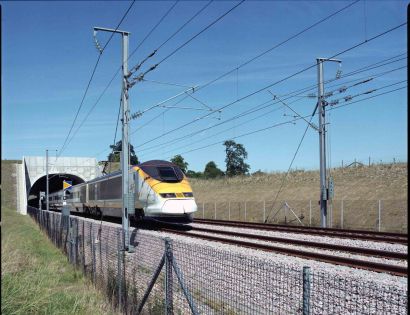
“Let High Speed 1 be the first stage of the revolution and start planning now for High Speed 2 and beyond.
“We desperately need a vision, a vision that created our networks in the first place, and I am delighted the Liberal Democrats are showing the vision that is slightly lacking in the Government.”
North West Lib Dem Euro-MP Chris Davies chaired the meeting, saying he came from the region that “opened the world’s first inter-city railway in 1830 between Liverpool and Manchester.
“I look at our 68 miles of high speed line – we are being left behind and I find it deeply distressing.”
Civil engineer Colin Elliff told the meeting that high speed lines needed city centre termini rather than parkway stations on the edges of towns, to prevent causing environmental damage, and that Euston is perfect for London’s station.
Ultimately, high speed lines should link the Channel Tunnel and the continent with London, Birmingham, Manchester, Liverpool, Newcastle, Edinburgh and Glasgow, with further phases to include Plymouth, Cardiff and Aberdeen.
The improved connectivity would provide regeneration benefits and address the economic ‘tilt’ of the UK to the South East, he added.
But transport journalist Christian Wolmar told the event that there was no obvious route for a high speed line, unlike in France where it linked Paris and Lyons, the two biggest cities.
He said France, like Italy and Germany, was a much bigger country, but Britain’s two biggest cities, London and Birmingham, are barely 100 miles apart.
“We do not need a high speed line between them. This is an idea without a purpose – because other people have got it, we must have it.”
Wolmar said it would not be environmentally friendly, as “considerable demolition” would be required: “There is no easy route into London, Birmingham or Manchester.”
And he noted that in France and Spain they had been prepared to fund high speed lines, and run them at cheap prices by a largely nationalised network “to ensure people use the lines, rather than maximise the profit.”
But he claimed “in Britain we do not do things like that a privatised rail industry will not deliver high speed rail”.
Wolmar suggested it would be better to spend the huge sums involved on “modernising and simplifying the existing network”.
And he concluded: “I think this is a branch line down which we should not go, as it will lead us straight into the buffers.”
UK ‘left behind’ in high speed rail future, warns Euro-MP
30th September 2008