
PRESENTATION of a significant award for environmental stewardship has been accompanied by a warning that railfreight needs to match the pace of road transport innovation.
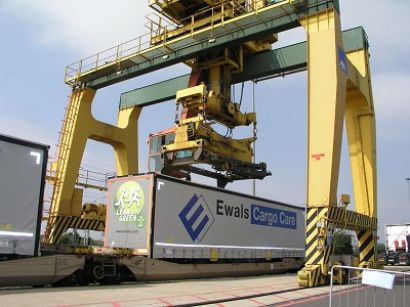
The Co-operative Group’s food logistics team collected the Award for Environmental Contribution during the Multimodal Exhibition and Conference at the NEC, Birmingham. The award recognises environmental stewardship resulting from switching flows of products from the roads on to the UK rail network.
Working with its rail provider, W H Malcolm, Co-operative Food has saved 570 tonnes of CO2 emissions by cutting one million road miles. One of the presenters of the award – Falklands War veteran Simon Weston – said Co-op Food had diverted 35,000 tonnes of goods to rail.
But, he added, the company was also warning that future decisions would be more difficult unless the railfreight sector could match the pace of road transport innovation. It was currently falling behind, he warned.
Justin Kirkhope, Co-operative Group’s project manager of logistics strategy, had earlier told delegates at the conference: “As the road industry’s marginal costs keep coming down, rail needs to keep pace. It’s critical, first and foremost, that we’re a successful business.
“Customers expect food to be on our shelves in store 24/7. I want to send the same products to our distribution centres (DCs) and to each store, but there’s a significant restriction if I can supply from Sunday to Friday and not on a Saturday night.
“Can we divert if there’s engineering work on a Saturday?” he asked. “Is there another path available?”
Rail providers need to offer a seven-day solution even if this does not mean seven days actually on the tracks, said Kevin Greenaway, national planning manager for Sainsbury – which recently opened a 93,000 square metres facility at Daventry International Rail Freight Terminal (DIRFT), underlining its commitment to rail.
Mr Greenaway said: “When it works, it’s perfect; but it [rail] is a tiny proportion of our movements, as it is for all our competitors.” Road transport was flexible and had its own green agenda, he added, including dual fuel and double-deck trailers.
Hauliers could drive from a national DC to a regional DC, and then on stores.
“Trains go from A to B, then back to A again,” he said. “Rail does journeys from ports to the Midlands or up to Scotland work very well and are ‘greener’ than double-deck trailers can ever be, but on many routes it just doesn’t make sense.”
Chris Welsh, the FTA’s director of global and European policy, said to achieve Network Rail’s growth targets, rail freight needed to increase by six per cent a year.
Seven-days-a-week availability was essential to intermodal growth and rail operators must respond more quickly – the FTA target is six hours – to service requests, he argued.
Shippers were also calling for longer trains to produce the economies of scale retailers need to convert from road transport, and Mr Welsh welcomed the fact that Network Rail now accepts 775-metre trains as the planning standard for freight upgrade schemes.
Network Rail freight director Paul McMahon said the company supported the concept of the Freight Transport Association’s ‘Agenda for More Rail Freight’. The UK rail network carried almost 25 billion tonne/kilometres of freight in 2013-14 , he said, with a sharp drop in coal volumes behind last year’s 2.8 per cent fall, but intermodal and construction traffic was strongly up.
• The concerns expressed at the Multimodal conference came shortly after the managing director of GB Railfreight John Smith said he felt the lack of rail capacity on some routes could hamper the growth of firms which rely on railfreight.
Writing in SupplyChainID, he said: “To solve the growing crisis, we need to create a long-term plan for the future. We need to be investing in our port, road, rail, inland terminal and network infrastructure.”
He also called for a review of the siting of Strategic Rail Freight Interchanges and consideration to be given to breaking up the ‘monopolisation’ of port rail terminals and inland terminals, so giving open access for the wider railfreight industry.